Where is your bliss station? You have to try to find it.
— Joseph Campbell
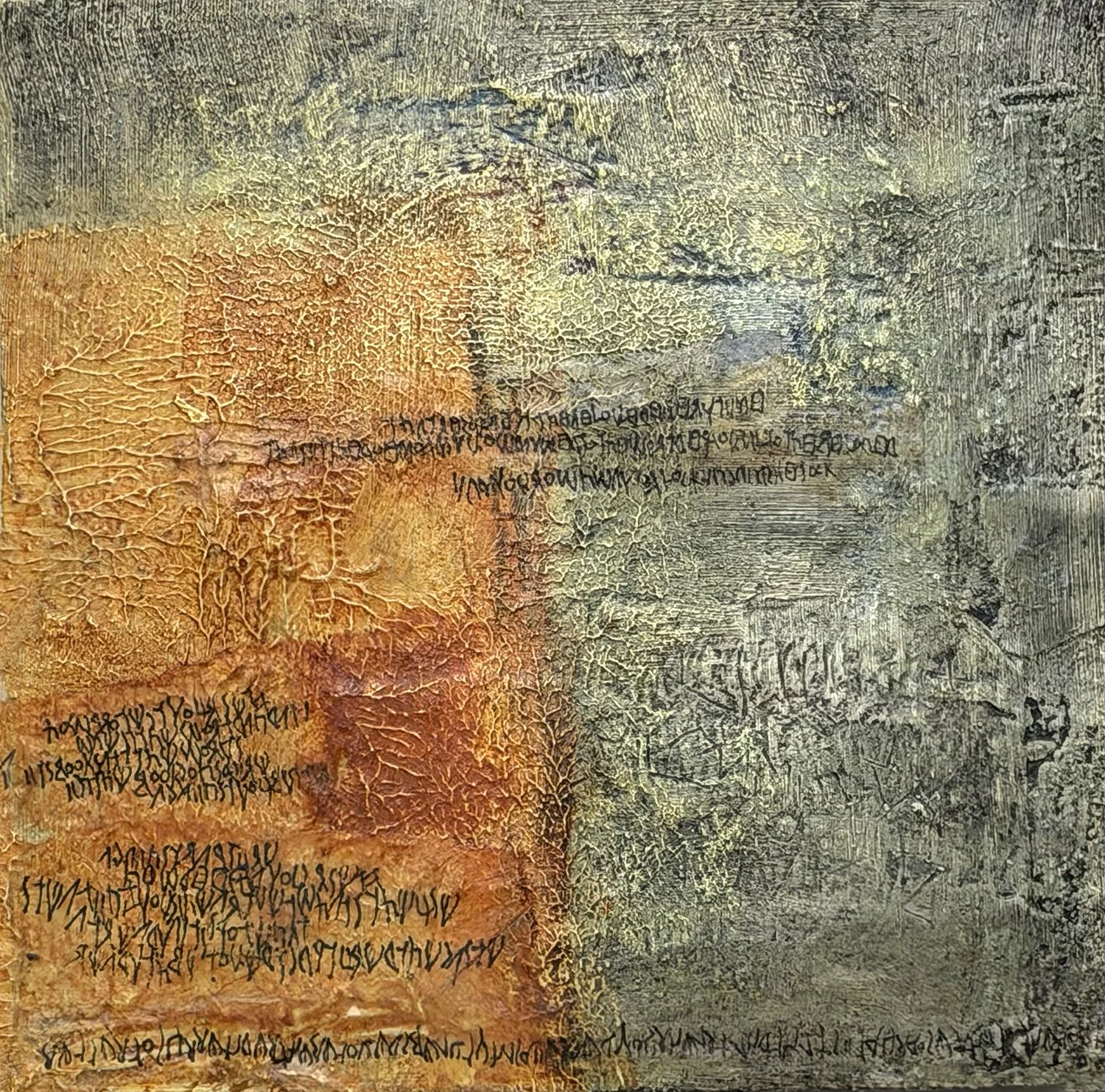
Secret Power of the Alphabet I | oil on wood | 5” x 5” | © Laurie Doctor
This morning I set aside my worry, ambition and anxiety and put on Van Morrison pleading See Me Through to begin time to play. The usefulness of having something as mundane as a routine is common knowledge, and sometimes the only way to regain footing; people often miss the fact that routine is integral to the creative process. Today I am reminding myself. Creativity requires structure. This last month my mind has been tumbling with the push of the world as well as my aims to finish my online class, complete work for exhibitions, develop in-person classes, painting, writing and keeping a garden alive in 100 degree heat. So what gets left out of my routine? The most important part— (besides dreams, prayer and meditation)— play.
Play is always a matter of context. It is not what we do but how we do it.
— Stephen Nachmanovitch, Free Play
Yes, the matter of context: the kind of play that engages the body, all of our senses and a period of uninterrupted time.
If we operate with a belief in long sweeps of time, we build cathedrals; if we operate from fiscal quarter to fiscal quarter, we build ugly shopping malls.
— Stephen Nachmanovitch, Free Play
Now, at the end of the day, I discover once again how playing facilitates everything. It’s as if the painting awakes and plays with online tasks, takes a left turn into teaching, which plays with writing to you. Now, instead of these interests competing with each other for time, instead of me being overwhelmed, all these passions collaborate. My day is full of surprises.
“Here I am squandering
time, the more
I squander it, the more
generous it becomes.”
— L Doctor
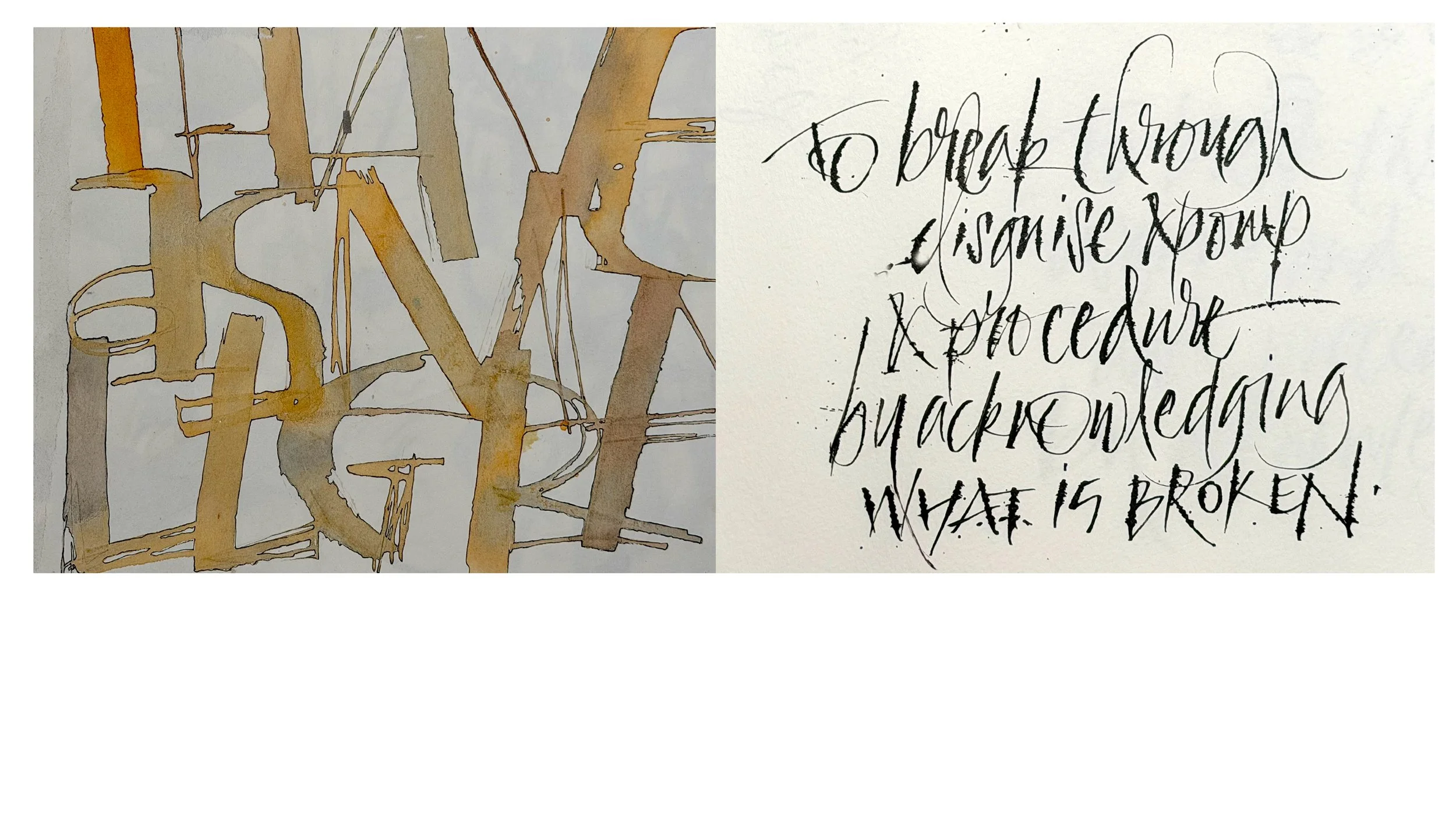
To break through | Sketchbook experiments with automatic pen (left) and ruling pen (right) | © Laurie Doctor
This is what I do — help people find their way into diligence and delight by connecting hands and heart, mind and spirit, body and trees, mind and sky. Yet this, too, is a collaboration — I do this by practicing and sometimes failing, and by what I learn from you, and sensing you on the other side of my pen.
Inspired by the fact that I will soon be teaching “Habit of Twilight”, I have resumed the practice of sitting quietly at dusk, at twilight, for about ten minutes (I have nothing to keep time). All of you who love the natural world know the magic of this liminal time. But wherever you are, in city or country, the practice of twilight is something to notice. What emerges from the changing-light-stillness? Are the chimney swifts flying back to their chimneys? Are there any bats where you live? Do the lights of the neighborhood or town change? What part of the sky can you see? What is in view out your window?
It’s so important to remember that an act of stillness, of noticing, of devotion, is a gift the world desperately needs.
My husband and I recently returned from a road trip to Springfield, Ohio to see with our eyes and walk with our feet, the plight of the Haitians. The sorrow in the young man’s dark eyes — the one who finally answered our knock on the locked and closed Haitian restaurant, the one who opened the door a crack and said “we are closed ‘cause of the troubles”, the one who looked behind him at the back of the dark shop where his mother stood, not cooking — his sorrow was thick in the air with all the invisible others. The parking lot was empty, even ICE and police cars had left. The Hispanic grocery next door was the only place open, with three customers, one of them a young dark-skinned man wearing an ankle bracelet. The grocery clerk spoke of how the Haitians have uplifted the community and confirmed they have nowhere to hide and nowhere else to go. She said they are being shipped to somewhere in Africa.
It is increasingly more urgent and more difficult to combine compassion and action with the practice of being still, of having uninterrupted time. Joseph Campbell spoke about this necessity before the madness and increased speed we have grown accustomed to with screen time.
“You must have a room, or a certain hour or so a day, where you don’t know what was in the newspapers that morning, you don’t know who your friends are, you don’t know what you owe anybody, you don’t know what anybody owes to you. This is a place where you can simply experience and bring forth what you are and what you might be. This is the place of creative incubation. At first you may find that nothing happens there. But if you have a sacred place and use it, something eventually will happen.” — Joseph Campbell
Last night, sitting on our veranda, exercising a habit of twilight, once again I found the consolation of closing my eyes and listening. First to the right, at the tops of the trees, then to the left, and even higher up some percussion punctuating the hum— a late summer cicada chorus. It reminded me of the “sound drawings” I was doing for awhile — eyes closed, a tool in each hand, recording sound. The epitome of play, as the drawings are useless — yet this act of responding to sound with my body-recording is joy.
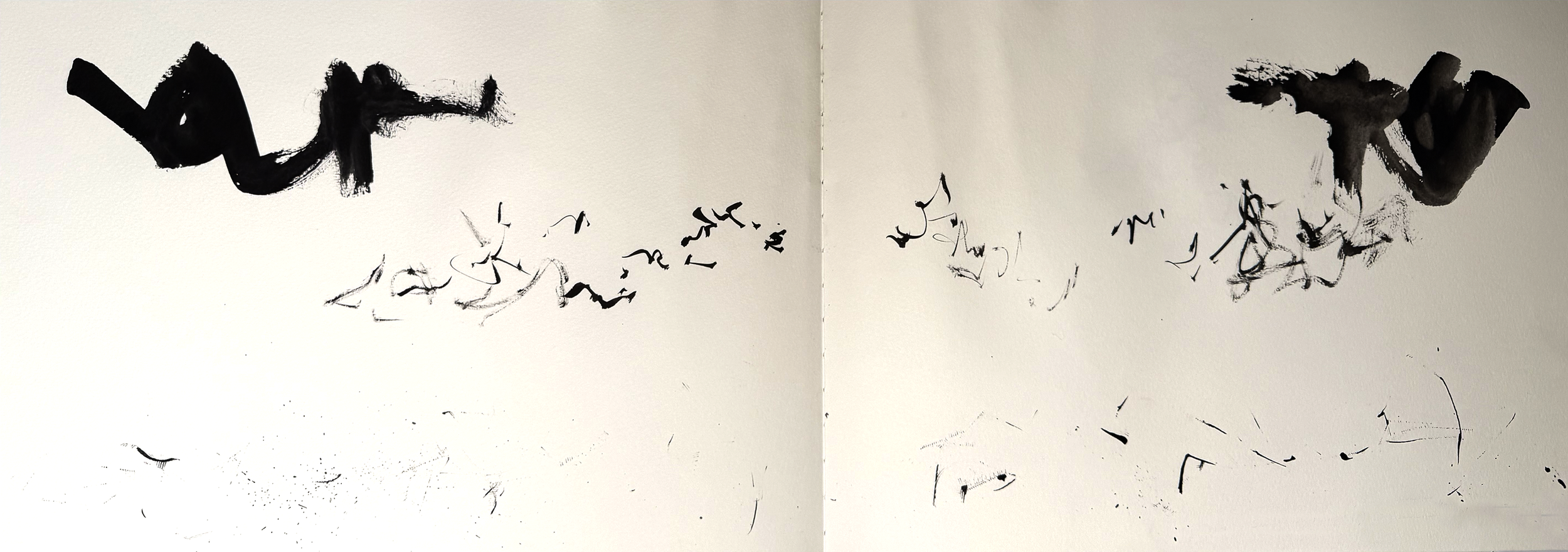
Sound drawing | © Laurie Doctor
The image below is of “sound writing” to music from my class in San Francisco:

Sound writing | © Meredith Klein
The video below, and the painting at the top, are other examples of my play this week (and many previous sessions)— works in progress that may be different by next week. Below I am writing with a pointed brush and oil paint on an oil painting:
Have you been playing? Do you engage any children (or do they engage you) in play? I’d love to hear from you.
This month’s featured artist, Linney Wix, is an art therapist, visual artist & writer who received a Fulbright award to the Czech Republic for research. A book that developed later, Through a Narrow Window, has images of paintings from the children who were kept in the Terezín concentration camp near Prague during Nazi Germany’s occupation. They were secretly taught art by their heroic teacher, Friedl Dicker-Brandeis.
As Linney writes: In order to see, I must make. My work shows me where I am. See more of her work and writing here.

Fall Fruits - Pleasure Is Required | © Linney Wix