“Occult Power of the Alphabet”
— Gregory Orr
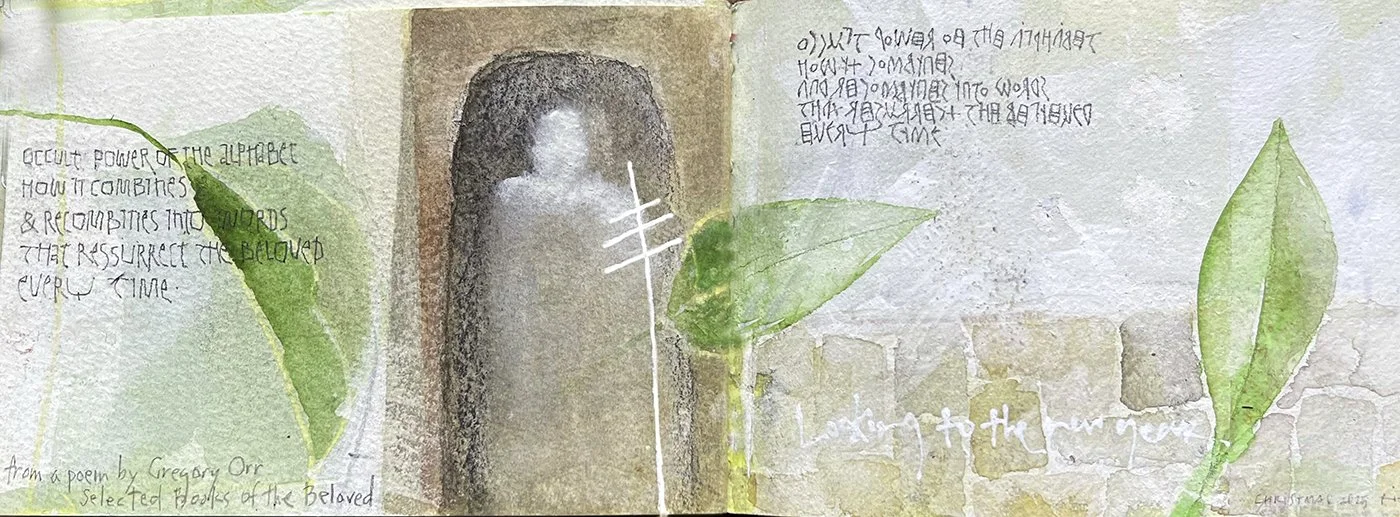
The occult power of the alphabet | from a poem by Gregory Orr | Selected Books of the Beloved | © Laurie Doctor pocket sketchbook
In last month’s post, remake your world with words, we talked about the change-making potential of words and story. In this New Year’s post we will continue with this idea, sparked by another line from Gregory Orr’s poetry: the occult power of the alphabet. How can words, letters and stories become allies for hope and vision in this new year? Here is the first stanza of a much longer poem by Gregory Orr:
Occult power of the alphabet —
How it combines
And recombines into words
That resurrect the beloved
Every time.
The image of making words and recombining them, the feeling of resurrecting the beloved, stops me and fills me with desire to combine and recombine words. To feel the presence of the beloved. The last line of this stanza is only two words: every time. It resonates because this line is not folded into one compound word, but is two separate words with a pause in the middle. This vanquishes any doubt about the beloved returning. Now I am convinced that what the poem says is true; the alphabet, writing, has the power to resurrect the beloved every time — I only have to be willing to stay with it, to wait, to make myself an instrument, to be devoted to the time it takes.
The great wave is in waiting for any boat…
The worst is not to be overwhelmed by disaster, but to fail to live by principle.
— Sister Wendy Beckett
On Christmas night Steven and I read aloud to each other — astounding mind-stopping sentences from Roberto Calasso’s The Marriage of Cadmus and Harmony. This got me thinking of making room inside for this new year, and the power of words:
… to scoop out a vacuum in the material world, to lighten its density, to fashion a sounding box between skin and shade.
What follows is a new story, in which something has been taken away from the density of the body to house the vacuum of the word.
— The Marriage of Cadmus and Harmony | Roberto Calasso
Even if I don’t know what it means to fashion a sounding box between skin and shade — the image is compelling. I imagine the sounding box as my body-mind-spirit, and to be a sounding box means being empty and open. There is room for the mystery between myself and the darkness of the world, between skin and shade, between what is and what is evermore about to be. The sounding box has a song for the future.
Then I noticed that the word vacuum actually mirrors itself, has space inside it, a vacuum in the middle, because of the two consecutive u’s. (We have only a few words in English with two u’s together, and one of them we took from the Hawaiian’s — muumuu.) Vacuum comes from the Latin vacāre, meaning empty space. In English emptiness often has a negative connotation, a feeling of loss, but it is lovely for the new year to think of emptiness as the quality of readiness, of active waiting for what wants to come, to house the vacuum of the word.
The Latin root vacāre turns empty space into a verb meaning to be left free, be available; to be free from other occupations or engagements. I feel the magic of transforming something lost or taken or empty into a new kind of freedom. This is what I reach for — at least for some moments — to be free from other occupations or engagements, to be a receiver who believes in a receiver. To be fully given over to what it takes to resurrect the beloved.
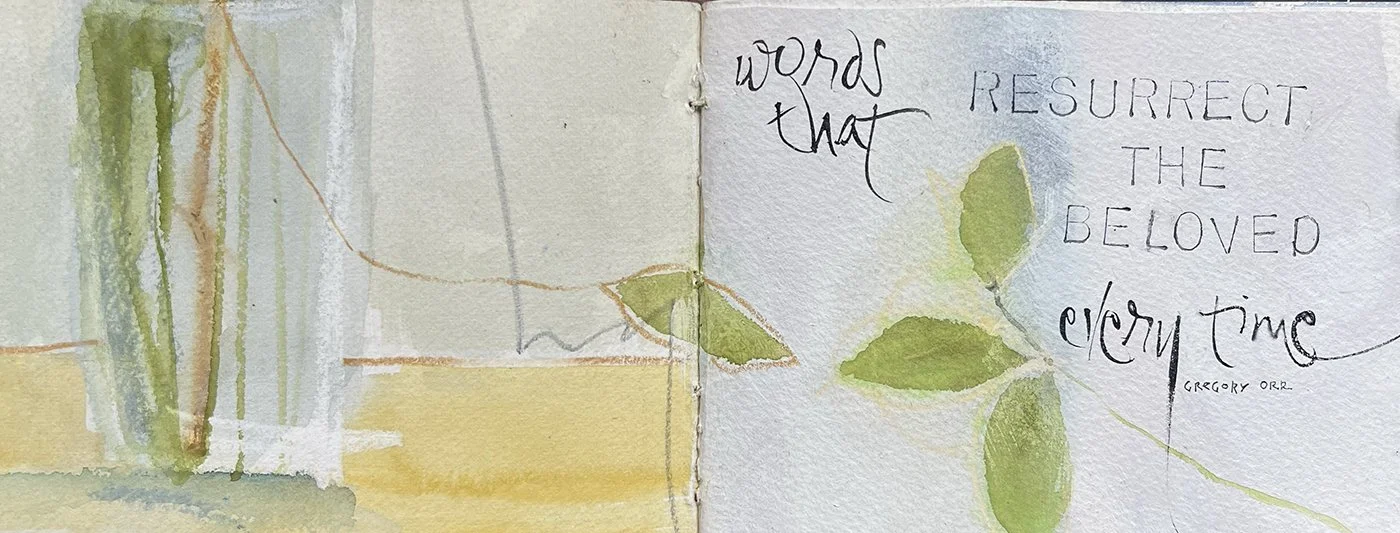
words that resurrect the beloved every time | from a poem by Gregory Orr | Selected Books of the Beloved | © Laurie Doctor pocket sketchbook
Doesn’t all creation come out of emptiness, darkness and night? In our own creation story we have an image of empty space as a kind of sounding box — out of the darkness and the void comes sound — in the beginning was the word. Emptiness is the condition of something taken away so that we may receive and feel the power of the word.
What does it mean to not be overwhelmed by disaster, to live by principle? The wise ones and poets tell us again and again that the grounding, uniting principle is love. This is what will get us through, is what brings me to you. It is what propels the willingness, desire, and perseverance to awaken the beloved.
Later in the same poem, Gregory Orr invokes hope and love:
If somewhere in us
Love lurks,
The beloved
Will find it.If hope hides
In the smallest
Cranny,
The beloved
Will pry it out.Demands it.
Won’t take no
For an answer.His poem
Luring it to the surface.
Her song
Calling it forth.
It’s the new year, time to call forth love and hope.
Below is a demo of me working with this poem in my studio and writing in my sketchbook.
© Video by Rachel Waters
What are your words for calling forth the new year, for resurrecting the beloved? I’d love to hear from you.
Let me introduce you to the inventive and elegant work of this month’s featured artist, Lois Rossiter:
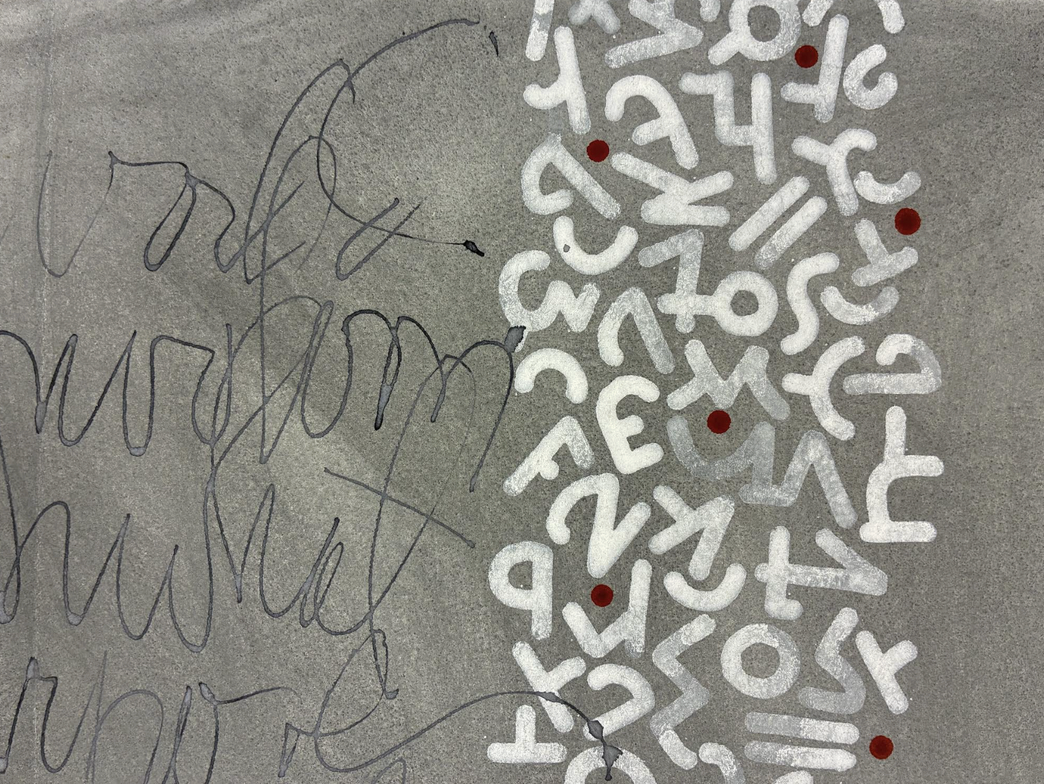
© Lois Rossiter
See more of her work here: