Featured Artist | August 2026
Barbara Courtney
© Barbara Courtney
Tell us a little bit about your practice as a maker.
Until ten years ago, writer, artist, and teacher were not words I applied to myself. One by one each arrived, slowly delivering something of itself, including a set of unspoken expectations. Each also carried the question: what makes one so?
My creative practices feed each other. I search for a perfect word much as I search for a perfect shade of red. Words combine to form sentences which combine to form paragraphs which combine to form essays, much as lines combine to make shapes which combine to make a unified image on a single page.
Where do you thrive? Where do you struggle?
Because creative practice still feels new to me, it often seems outside the identity I hold of myself. At Laurie’s retreats, surrounded by like-minded people, spending days where my only task is to paint, to listen to words, and to experiment with ways to express them on the page, it’s easier to fall into the artist’s way. Returning home, being called to the tasks of my life which don’t include creativity, makes it easy to let those same pleasures slide away.
One of the challenges of new practices is embracing the unknowing. It’s taking a seat at a table in a group of writers or artists who I am certain are better at whatever we’re doing than I am. My writing practice is closely tied to my teacher’s Zen Buddhist practice. In seated meditation, we follow our breath, see our minds wander, and gently bring ourselves back to begin again. We extend this to any artistic practice when we begin again by returning to the page with brush or pen. “No day without a line.”
I also return to the Zen monk and teacher, Suzuki Roshi’s words on the expansive nature of beginner’s mind. In the beginner’s mind there are many possibilities, but in the expert’s mind there are few. In this state of not knowing, I can meet the world with curiosity and questioning, with uncensored engagement. This has become the goal of my place of practice.
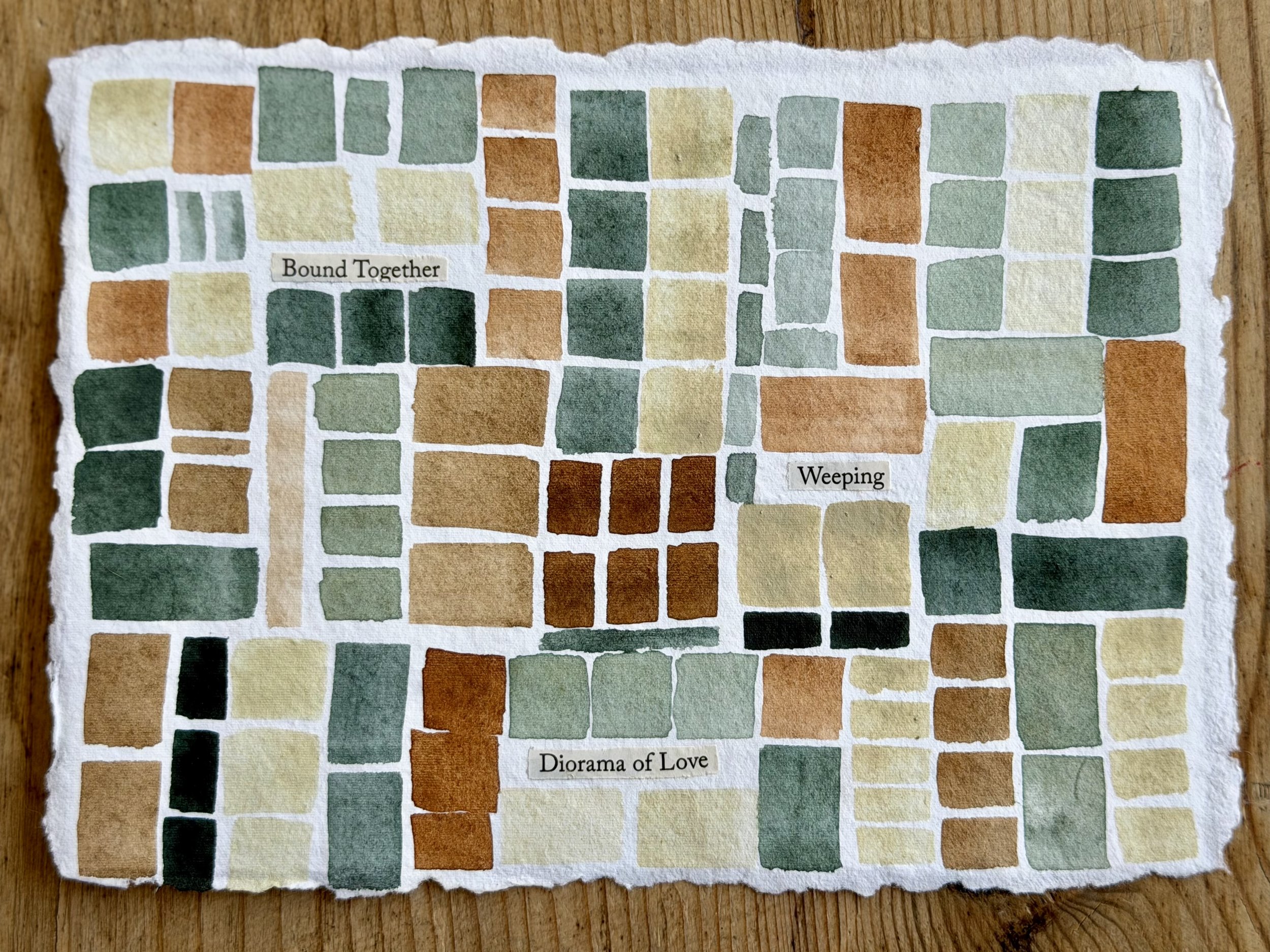
Words cut out of a New Yorker and watercolors © Barbara Courtney
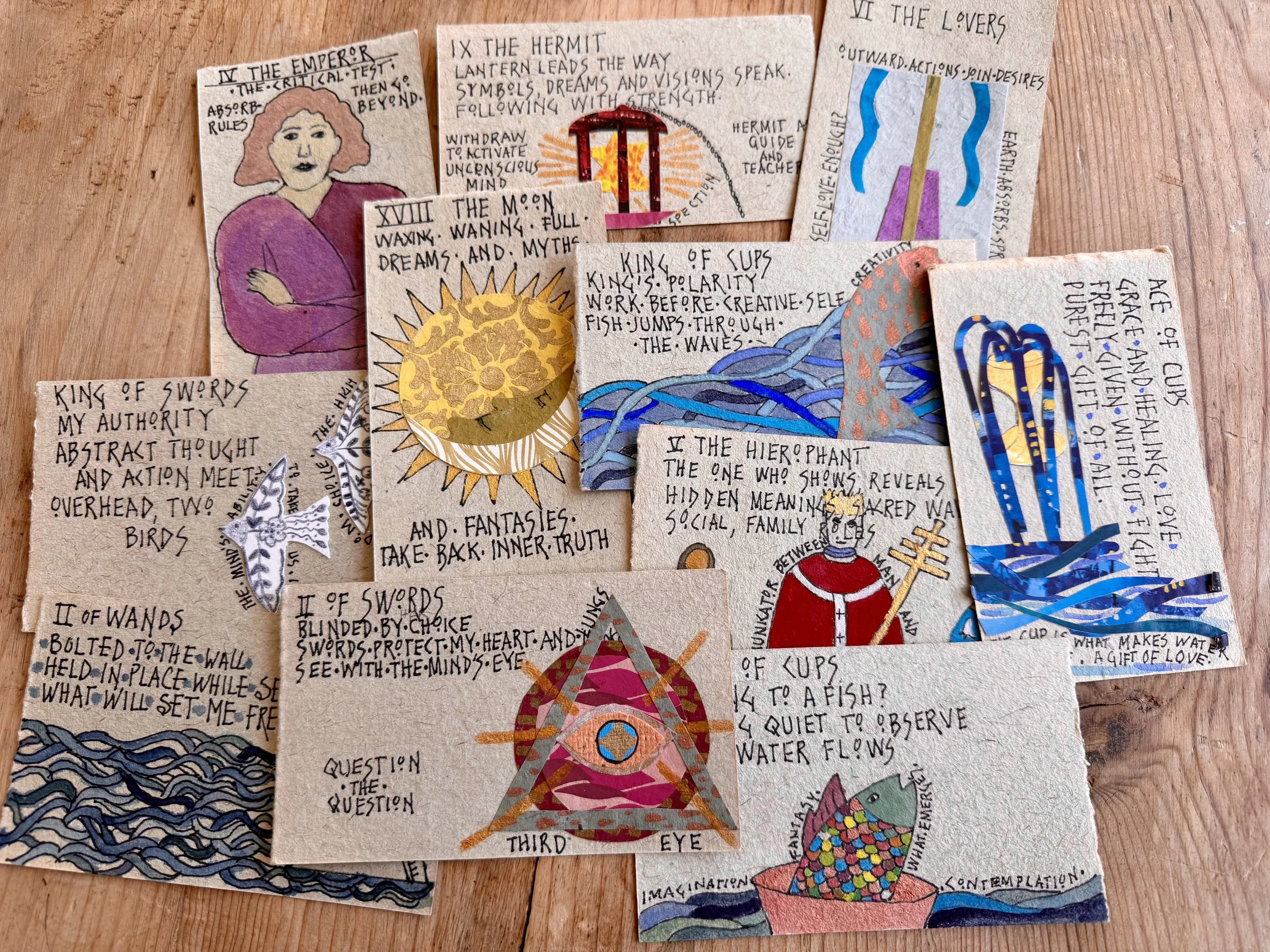
I drew a Tarot card every day and made an image and haiku to represent it. © Barbara Courtney
Who/what influences you?
Over the past ten years, I’ve studied writing practice with author and educator, Natalie Goldberg. In writing practice, I learned to follow the wandering pathways of my mind, to drop below discursive thinking, recording memories and feelings on the page. I gave voice to those words when we read aloud, experienced the absence of praise or blame when the words were received without comment.
My creative practice expanded when, during the pandemic, Laurie offered an online class, donating the proceeds to Mabel Dodge Luhan House, a place she holds in her heart in the same way I do. I joined in to support Mabel’s and left with a newfound excitement. Words combined with watercolor. The blank canvas of a sheet of paper, marked with a mix of abandon and intention. Folded, creased, torn, assembled. A book that I could hold in my hand. The magic of it.
In March, poised in front of a sheet of Rives BFK in Taos, Laurie invited us to “inhabit the twilight.” To enter that space where our world takes on a different form. In the liminal space between daylight and evening, lines soften and blur. Black and white shifts to shades of gray. I wondered about how this mindset might change my focus. About how to look at a landscape and see a wash of color. About how to listen to a poem and respond to the emotion of it with the stroke of a brush.
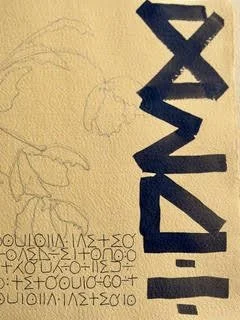
I embraced Laurie’s instruction to find a phrase I love and write it repeatedly. To crack open the bones of a letter, a word. What is the meaning of beloved, of poem as Greogry Orr uses it in his poetry? How can you create an alphabet that renders words as art? How do we enter this place of twilight and what does it feel like to be there?
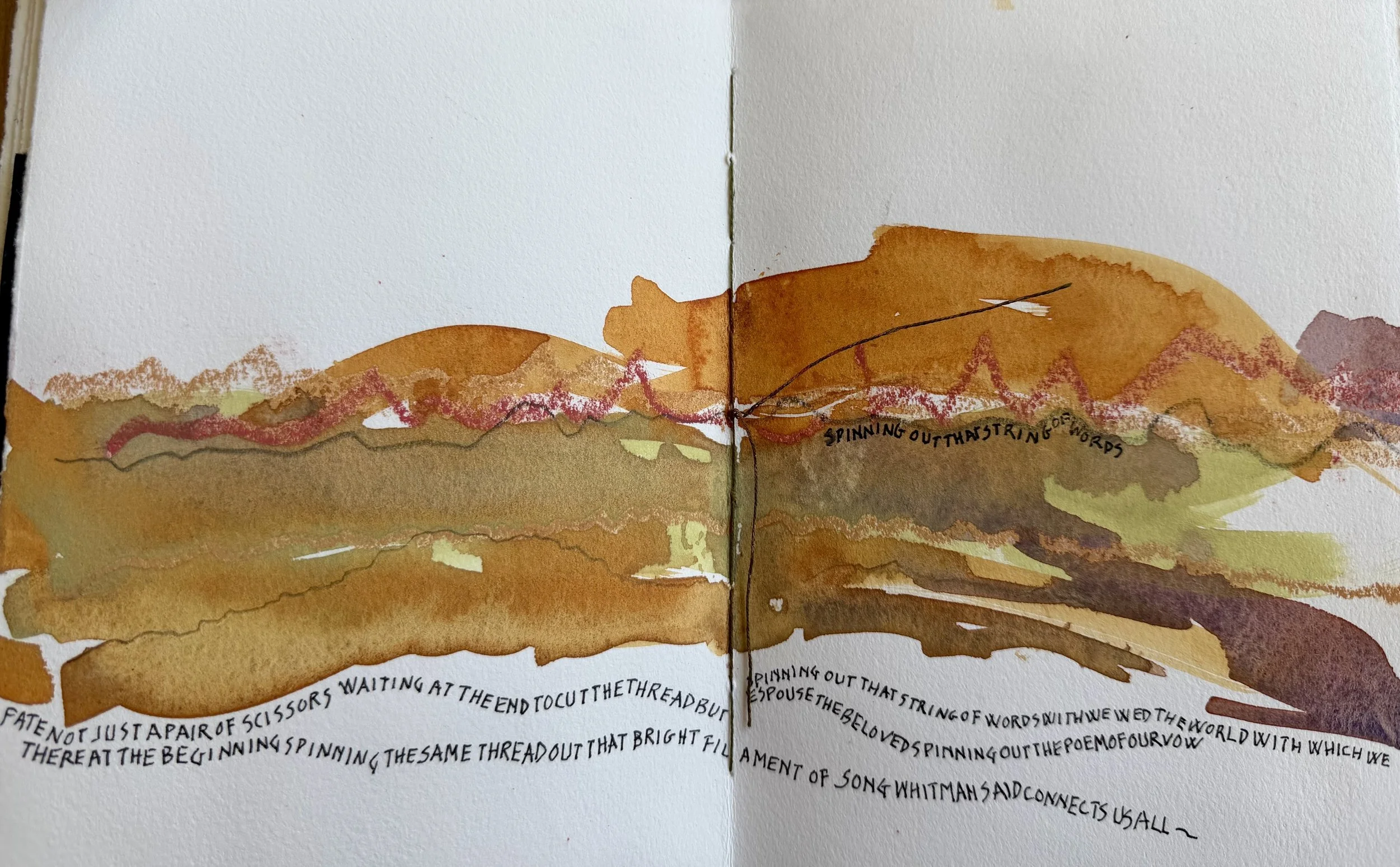
Page from Taos journal © Barbara Courtney
What is one intention you have for your practice this year?
Natalie Goldberg says, Writing is essentially a visual art. You want the reader to see what you are saying. I’m curious about the intersection of my practices. How do words inform my art and how does art help me access words. I wonder if I could create an image to express the emotion of an essay I’ve written. This year, I’d like to find out.
Also, I’m endlessly envious of Laurie’s ability to memorize and recite poems. The delivery changes when the words have become embodied. I’ve tried and failed to memorize a poem in the past, but this year I’m determined. Laurie says that one of her tools for memorization is to repeat lines as she walks. I’m training for a 10-day hike in September so there will be plenty of solitary walks between now and then. The perfect opportunity!
See more at Barbara’s Website.